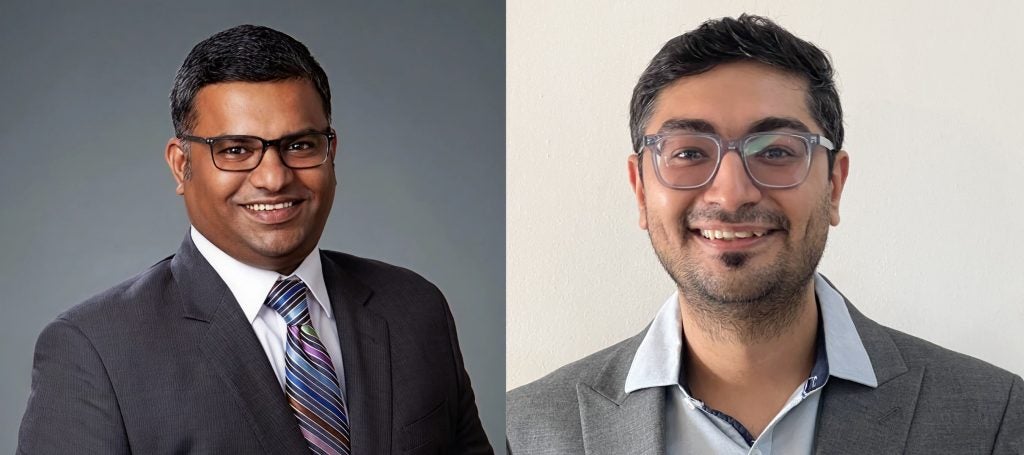
Deutsche Bank thinks it has a ‘phenomenal opportunity’ to
make itself a UK private banking heavy hitter. Its new UK head, Tom
Slocock, talks to John
Evans about his strategy and a bunch of new hires aimed at
putting on bulk in London and its key uber-wealthy
segments.
Go deeper with GlobalData


Access deeper industry intelligence
Experience unmatched clarity with a single platform that combines unique data, AI, and human expertise.
The international private banking markets
based in London are seen as the acid test of prowess in wealth
management, a truly global wealth centre where any private bank has
to have amassed a significant client base to be regarded as a big
league player.
Getting into this exclusive club is the avowed
aim of Tom Slocock, UK head of Deutsche Bank Private Wealth
Management (PWM), who started with the bank this March. A
well-regarded private banker, Slocock was formerly head of
international private banking at Credit Suisse in London. He also
had spells at Goldman Sachs and Lehman Brothers.
Deutsche Bank, a bank that enjoyed a flight to
quality reflecting its strength and stability when a number of
rivals wilted during the credit crisis, has a “phenomenal
opportunity” to build in the UK, he asserts. But he is quick to
concede that there is quite a job ahead of him.
Deutsche Bank bought Tilney Investment
Management, a regional wealth manager nearly three years ago to
help bulk up in the UK and which has in-depth coverage across most
of the UK.
But now the job is to “deliver the
capabilities of Deutsche Bank in a marketplace where until
recently, the bank did not have a meaningful presence,” he says, in
an interview with PBI.
“We want to expand our coverage within the
London area and also in the higher end wealth spectrum.”
For a major bank like Deutsche Bank to not
have a sizable wealth management business in the UK is an obvious
gap, he concedes.
In pursuit of this push, Deutsche Bank has
just made a series of high-level London-based hires from UBS,
Credit Suisse and Barclays Wealth.
The new recruits include star ex-UBS private
banker Melanie Cassoff, who spent seven years building an
entrepreneurial and City of London client base, as well as
additional UBS hires with ultra high net worth (UHNW)
expertise.
In addition, Andreas Wichmann and Joe Knight
join Deutsche from Credit Suisse. Wichmann was responsible for the
Investment Consulting team and Knight was responsible for
attracting and managing European clients.
Robin Perry joins from Barclays Wealth, where
he was responsible for the research and analysis of the fund
proposition. Prior to Barclays, he was an investment trust analyst
at Gerrard and a portfolio manager at Schroder Personal Investment
Management.
“The appointments represent an important step
in the realisation of our growth ambitions for the UK business,”
said Slocock.
The hires bring Deutsche Bank PWM’s headcount
in the UK to about 250, the majority of which joined with the
acquisition of Tilney, which has a network of five offices across
the UK regions in addition to the London office.
Deutsche Bank PWM has about £6 billion ($9.9
billion) of client assets under management in the UK, which just
about edges it into the top 20 UK private client managers. The UK
rankings are dominated by firms like Barclays Wealth – the leader
with £27.3 billion of private client AuM.
Even German-owned rivals like Kleinwort Benson
have £6.8 billion, although Kleinwort has been put up for sale by
owner Commerzbank as an EU condition for extensive German
government state aid.
Where would Slocock like to be in the UK
league tables – a top 10 player in the future?
“To be honest, I am much more interested in
quality than size for size’s sake. I am not committed to reach a
certain size or ranking although, of course, Deutsche Bank can and
should increase in size because we are known as high quality
provider and a very sound business,” he says.
So, what is the competitive edge that Deutsche
can boast versus its rivals?
“The strong capital position of Deutsche Bank
and the flight to quality among clients has certainly helped our
brand strength and awareness among clients, as well as with
potential staff recruits and other professionals in the wealth
industry,” Slocock says.
“At a time when other sources of financing are
extremely rare, our ability and willingness to lend to clients, not
just against standard collateral assets, has resulted in
significant increases in the level of activity in the year to date.
“
And that is a key to the Slocock strategy,
leveraging Deutsche Bank’s various strengths including its strong
capital position so his team can “really work with clients to find
solutions to problems, including those involving financing and
leverage.”
Deutsche Bank has so many leading franchises
and business lines globally, like advanced foreign exchange
structuring, which the PWM team can tap on behalf clients and
where, Slocock admits, “these have not really been penetrated into
the UK.”
He gives as an example the complex financial
structuring of a client’s art collection: “The client had very
significant assets in a range of asset classes and had significant
wealth tied up in these investments. The job was to create
liquidity and we drew in the relevant experts, internally and
externally, to structure a solution.”
For Slocock, the financial upheavals of the
past year also involve a sea-change in the qualitative relationship
with clients.
“We are having a very deep look at how we work
with clients and to find out what they are really trying to
achieve. So far we are seeing good results,” he says.
Meanwhile, Slocock is a firm advocate of the
open-architecture approach, buying in investments and ideas from
third parties so clients can get a best-of-breed service.
Most of Deutsche Bank’s client accounts are
discretionary but he says that, essentially, there is not a great
deal of difference from a proposition point of view in what is
offered through a discretionary or advisory service because the
bank is completely open-architecture.
This includes its Tilney business which
historically has dealt with a diverse set of investments partners.
In addition, Deutsche Bank PWM global head Pierre de Weck has
revealed that the bank has moved to a “more dynamic” investment
model to restore the confidence of private banking clients,
involving monthly reviews.
“The investment committee now meets monthly
and gives a very precise indication on asset variation. I force my
people to make a variation or to justify why they do not do it,” de
Weck told a recent industry conference in Zurich.
The very static investment models that mostly
relied on stocks and bonds at many banks were now outdated as four
global financial crises, Asia, Russia, the internet bubble and the
subprime meltdown meant investors had zero returns on equities over
the past 10 years, de Weck declared.
Meanwhile, Sal Oppenheim, Germany’s largest
independent private bank, is heading for eventual acquisition by
Deutsche Bank, which is negotiating to buy a stake in the
beleaguered bank.
Deutsche plans to complete a full takeover by
2011 after buying an initial 45 percent stake, Frankfurt sources
said. Deutsche Bank officials declined to comment but confirmed
that due diligence at Oppenheim has been completed.
Luxembourg-based Sal. Oppenheim is seen to be
worth €1.5 billion-€1.8 billion ($2.2 billion-$2.6 billion).
A deal with the smaller bank would strengthen
Deutsche Bank’s position with affluent private clients in core
markets including Germany. Oppenheim has been struggling after bad
investments in 2008, reporting a €117 million loss for the year. It
has cancelled the sale of its BHF-Bank wealth management
subsidiary, after receiving disappointing bids which didn’t come
near the €1 billion asking price.