
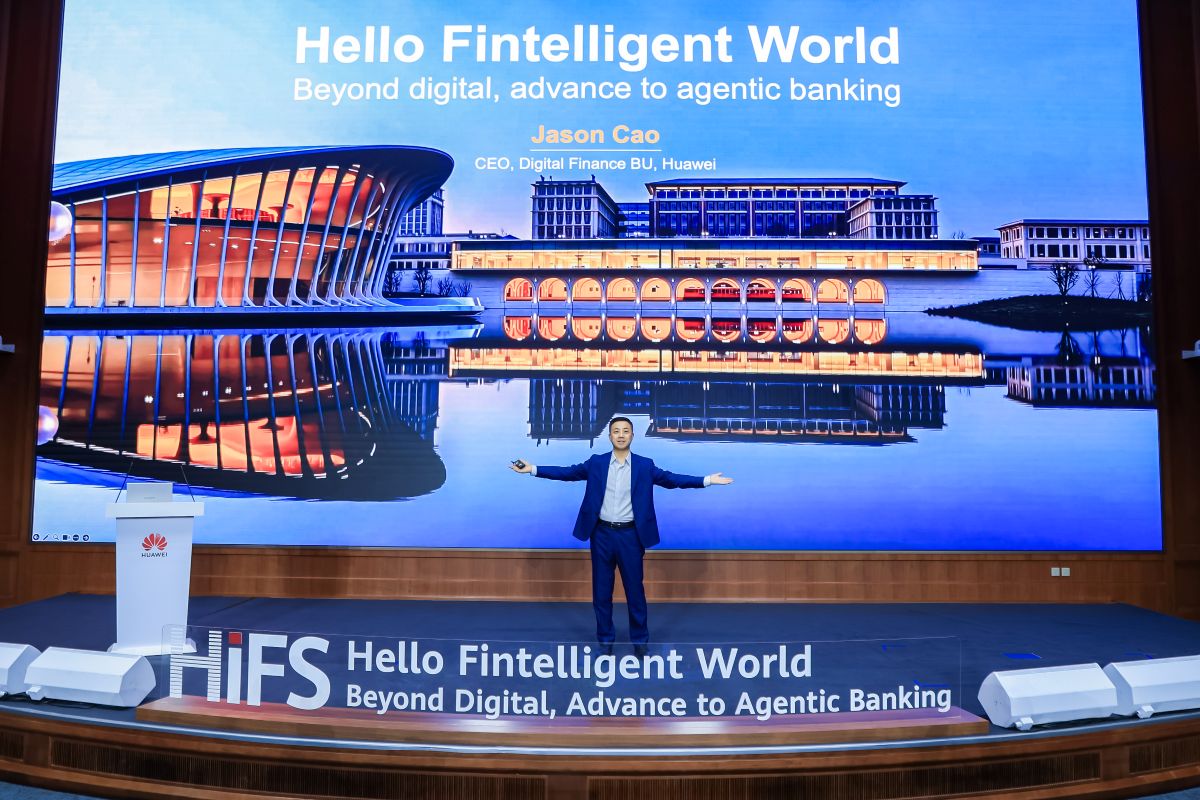
In his opening keynote, Jason Cao, CEO of Huawei Digital Finance BU, described how sixteen years of continuous innovation in core technologies, engineering, ecosystems and localised services have turned Huawei’s financial strategy from basic hardware and software into a full industry solutions flywheel powering its move into agentic banking.
Cao underlined Huawei’s positioning as a customer-centric company, highlighting how Huawei combines AI computing, data platforms and industry specific engineering to support banks and insurers.
During the global session Hello Fintelligent World: Beyond Digital, Advance to Agentic Banking, several clear themes emerged: a move to hybrid AI architectures (combining public cloud and on‑premise), the need for well‑governed, all‑domain data, the rise of ‘digital employees’ and AI agents in daily workflows, and the growing importance of openness in models, ecosystems and infrastructure.
Together, these illustrate an industry moving towards ‘thinking banks’ and AI native insurers that can operate more securely, resiliently and personally, while controlling long‑term cost and complexity. Addressing the audience, Cao noted: “We believe every user will have a ‘super steward’ to help manage their life and services and every employee in your organisation will have a ‘super avatar’ to help them get their job done.”
What is agentic banking?
Agentic banking is AI native banking where autonomous agents run end‑to‑end services, replacing rigid product stacks with flexible architectures that deliver VIP level personalisation, efficiency and rapid innovation.
Key components of agentic banking include:
Hyper personalisation: AI agents continuously interpret each customer’s behaviour and context to design and adapt services uniquely to them. This allows banks and institutions to truly understand each customer’s needs, configure tailored products, and deliver natural, conversational interactions.
AI driven decision making: Evolving beyond static analytics by embedding domain models and knowledge graphs, so that, in Jason Cao’s words, “The mode of making decisions is moving from data plus rules to ontology plus knowledge.”
Multiagent collaboration: Combining human judgement with AI colleagues that plan and execute tasks alongside staff.
Challenges and opportunities
Traditional financial institutions face several concrete challenges, with legacy core systems and fragmented data across hundreds of applications, making it difficult to give agents real‑time, end‑to‑end visibility over customers and processes. Governance and regulation are also still catching up, so banks must codesign AI policies and architectures with regulators while handling issues such as data residency and sovereignty that vary by market.
There are also substantial talent and organisational hurdles. Moving from isolated AI proofs of concept to scaled, production grade agent systems requires new AI engineering disciplines, redesigned processes, and strong guardrails to prevent hallucinations and unsafe behaviour, rather than simply placing new tools on top of old architectures.
However, the opportunities for growth and efficiency are significant. At the summit, examples showed how AI‑assisted coding and digital employees are already cutting development time and helping banks target meaningful operating cost savings. Document‑review capacity can be increased by a factor of five on the same hardware, while accuracy rises from around 85% to 97%. There is also a step‑change in fraud‑case handling, with AI agents clearing volumes in minutes that would simply overwhelm human teams.
At the business level, agentic banking enables hyper personalised, intent driven services so that, as Jason Cao says, “everyone will be a VIP,” creating deeper engagement and more precise cross and upsell. By building domain tuned models on their own data and expertise and running them on hybrid AI infrastructure with cost-efficient open-source models, banks can turn agentic architectures into a durable source of competitive advantage and faster innovation.
Huawei’s role in agentic banking
HiFS explored how global financial institutions are moving beyond digital experiments to build truly AI native operating models. Drawing on the expertise of more than 70 industry partners, Huawei and leading banks and insurers from China, Asia and Africa showed how agentic AI, open-source models and real‑time data platforms are being applied at scale – from credit decisioning and fraud detection to customer engagement, call centres, and core bank modernisation.
In addition, Huawei announced six key initiatives – scenarios, architecture, engineering, data, AI infrastructure, and talent; launched its Financial Data Intelligence Solution 6.0 and Digital CORE Solution 6.0; and unveiled a new resilient infrastructure for general‑purpose and AI computing to help financial institutions scale AI and accelerate digital and intelligent transformation.
On the AI side, Huawei supplies high-performance AI infrastructure such as Atlas SuperPOD clusters, hybrid AI architectures that mix on‑premise and cloud deployment, and an ecosystem built around open-source models and domain tuned financial models.
In data, Huawei’s FinData Intelligence Solution 6.0 and the RACE strategy (real‑time, all domain, converged and experience centric data) provide the real‑time, governed data foundation that agentic banking requires, often in partnership with specialists like TrustDecision for fraud and Sensors Data for hyper personalised marketing.
At the application and core system layer, Huawei’s 4M Digital CORE solution, AI coding tools for COBOL‑to‑Java migration, and cell-based cloud native architectures help banks modernise legacy cores into AI ready platforms.
Finally, resilience and operations for an agentic world are supported by RAAS based resilient infrastructure, DR RAAS 2.0, agentic AIOps appliances with partners such as Netis, and integrated inference solutions that make AI data centres practical within existing facilities.
Together, these contributions position Huawei as a full stack partner for banks moving towards AI native, agentic architectures.
